


Below is an excerpt from the PCC’s upcoming 2026 Evidence Report, APCM: Ensuring it Delivers Better Health. To learn more, join the PCC on October 29 for the release of our 2026 report by registering here.
In 2025, the Centers for Medicare and Medicaid Services (CMS) launched Advanced Primary Care Management (APCM) services. These APCM services and associated billing codes serve as an alternative bundled payment option for primary care clinicians to deliver and receive monthly payment for a group of care management activities.
In July 2026, the PCC conducted a short survey to gain a deeper understanding of the primary care community’s awareness and perspective on APCM services.
The survey was a convenience sample, drawing from the PCC’s distribution list of nearly 11,000 subscribers. List subscribers include: clinicians and care delivery leaders; consumer advocates; payers; employers; policymakers; and other champions of primary care. The survey was conducted from July 16 to August 6, 2026, and included 268 total respondents. Survey respondents who were not very familiar with or unaware of APCM were filtered out of the survey, leaving a pool of 176 respondents.
Limitations of the Sample
Because the sample is drawn from subscribers to the PCC—which has drawn attention to APCM services—respondents were likely to be more aware of the new services. Likewise, the PCC’s enthusiasm for the program and endorsement of shift toward new payment models means subscribers to our list are likely more inclined to view the services positively.
Because of these limitations, the sample was not intended to and cannot be interpreted as a representative sample of the entire primary care community; however, it does provide interesting insights into how some in the primary care community are viewing the program.
General Awareness and Interest in APCM
Survey participants were asked about their familiarity with APCM and provided four options:
- I’m very familiar with APCM codes and related services
- I’m somewhat familiar with APCM codes and related services
- I’m not very familiar with the APCM codes and related services
- I have not heard of APCM and do not know what it is

Awareness of APCM among survey participants was high. Only 11% of respondents had not heard of APCM and roughly 67% of respondents said they were either very or somewhat familiar with the new services.
Survey participants also indicated their organization was interested in the new services. Nearly 78% percent of care delivery or clinician respondents who had heard of the program indicated their organization was interested in APCM, and roughly half of care delivery or clinician respondents indicated their organization was considering had begun to adopt APCM.
The Draw of APCM
Overall, respondents seemed to view APCM services as a path to address the low (or nonexistent) pricing that exists for primary care services or to expand the team to better meet patients’ needs.

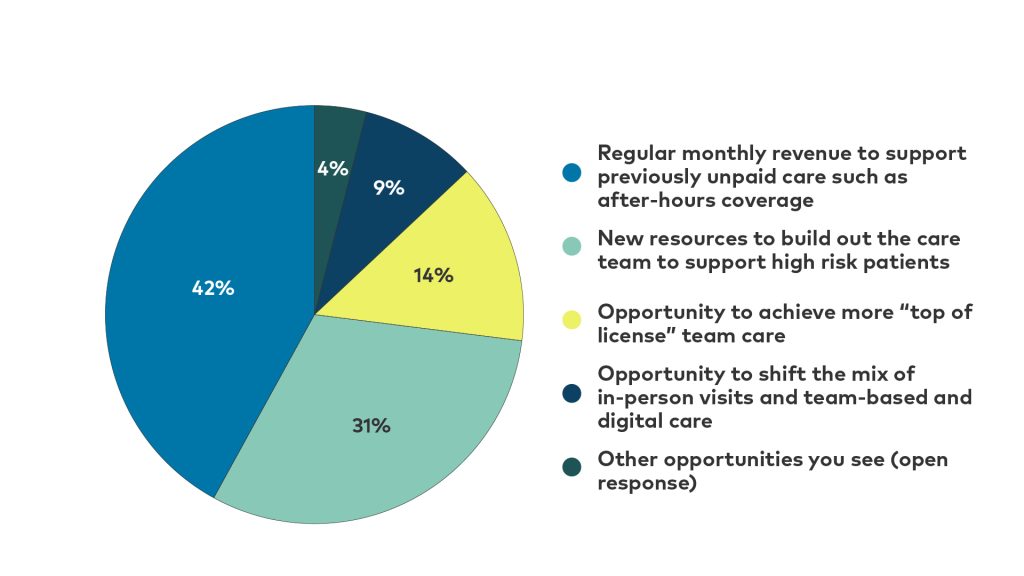
When asked to rank potential benefits of APCM services, a plurality (42%) of respondents selected “regular monthly revenue to support previously unpaid care such as after-hours coverage” as the top opportunity. Respondents also believed that APCM could bring “new resources to build out the care team to support high-risk patients”, with 31% of respondents selecting it as the greatest potential benefit of APCM.
Participants were also given the opportunity to write in other potential benefits from the services, and respondents consistently mentioned the potential to better address population health, broaden whole-person care offerings (such as nutrition counseling and stress management) and reiterated their interest in building out care teams.
Potential Hurdles to APCM

When asked to rank potential hurdles to effectively implement APCM services, most respondents ranked collecting monthly copays as the biggest challenge (42%). Likewise, when asked what one change Medicare could make to best help scale APCM adoption, 54% of respondents indicated that waiving copays for beneficiaries who lack supplemental coverage would be the most effective.
Behavioral Health Integration
Respondents were also asked about their organization’s current status with implementing behavioral health integration (BHI) and the importance of including BHI in standard APCM services (rather than as an add-on code).
While only 59% of the 135 care delivery respondents indicated they currently “provide and bill for behavioral health integration”, a notable 89% of total respondents believed it was at least “somewhat important” that “Medicare include integrated behavioral health in APCM.”
This survey and the 2026 Evidence Report is made possible thanks to the partnership of
