Newspaper with computer on table

What We’re Reading 4/17 and 5/1/26

Every other week, the Primary Care Collaborative (PCC) gathers major new stories, opinion pieces, research articles, case studies and more covering primary care. This special issue, however, covers both the weeks of 4/17/26 and 5/1/26.

 Want to submit a piece? Feel free to email the piece to PCC Communications Associate Maximilian Sandefer at msandefer@thepcc.org.


New Video Resource: The Power of Team-Based Primary Care: Sheri’s Story
The PCC, American College of Clinical Pharmacy
In this video from the PCC and ACCP, Sheri Conner and Rebecca Heath, PharmD, explore how a team-based approach to care has empowered Sheri as she provides care to her mother, who has dementia.

The video explores the relationship between Dr. Heath, Sheri, her mother and other clinicians, highlighting how the ongoing relationship between the care team, patient and caregiver has led to a better care experience.

New Resource: Advanced Primary Care Management: Successful Adopters Tell Their Stories
The PCC
On April 28, the PCC hosted a discussion with early adopters of the Medicare Advanced Primary Care Management (APCM) services and an AARP policy expert about their experience leveraging this new program. The webinar first, however, featured a surprise guest as Dr. Jake Quinton (Center for Medicare) joined in for a brief one-on-one conversation with Ann Greiner (PCC).


Primary Care Investment

Americans Are Fed Up with Our Broken Health System
Ann Greiner, the PCC
A new blog from President and CEO Ann Greiner explores how policymakers can tackle rising health care costs and why primary care investment should be at the forefront of this conversation.

Virginia Senator Introduces Bill to Boost Primary Care Workforce
Jessica Maldonado, WFXR
A new bill from U.S. Senator Tim Kaine, the Primary Care Team Education Care Act, aims to expand the primary care workforce through incentives and training support, reflecting growing urgency to address primary care shortages nationwide.


Medicare

Innovation Insight: CMS Invites ACOs to Apply to the New LEAD Model
CMS
CMS is inviting ACOs to apply to the new LEAD model, which aims to strengthen primary care through advanced value-based payment and care delivery approaches. The model focuses on improving care coordination and enhancing outcomes for Medicare beneficiaries.


Medicaid

Addressing the Impact of H.R. 1’s Medicaid Changes on Primary Care
The PCC
On March 31, the PCC hosted a conversation exploring how primary care and states can work together to minimize challenges arising from major Medicaid policy changes put in place H.R. 1.


Idaho Cut Services for People With Schizophrenia. Then the Deaths Began
Ellen Barry, New York Times
Idaho cut Medicaid-funded mental health services, specifically intensive, community-based care for people with severe illness. Within months, several patients died after losing support. The backlash forced the state to quickly restore funding, underscoring how cutting preventive mental health care can lead to immediate and serious consequences.


Downcoding

Insurer ‘downcoding’ penalizes physicians for doing their jobs (opinion)
Ari Geller, Hartford Business Journal
Clinicians say insurers are using AI to “downcode” visits, cutting critical payments for more complex primary care services. Geller warns this could hurt independent practices and make it harder for patients, especially those with greater needs, to get comprehensive care.


Pennsylvania health system sues Aetna over alleged ‘downcoding’ of inpatient hospital care
HealthExec, Chad Van Alstin
Jefferson Health has filed a lawsuit against Aetna, alleging that the insurer’s policy of paying outpatient rates for inpatient hospital care, a practice also known as downcoding, violates federal law.


Whole-Person Care

Mind the Gap: Bridging the Oral Health Divide for More Affordable and Accessible Coverage
Bailey Reavis, Families USA
As approximately 72 million Americans lack dental insurance, an informative article from PCC Member Families USA implores policymakers to “not make short-sighted cuts to dental benefits” as many states grapple with Medicaid budget cuts.


Why psychologists should be integrated into care teams
Nahal Delpassand, SmartBrief
Embedding psychologists directly into care teams, especially in primary care, can help address the mental and behavioral factors that strongly influence patients’ health outcomes. This underscores the importance of treating psychological needs as core, not optional, in order to forward whole-person care.


LEAD Gets the Diagnosis Right. Now CMS Has to Apply the Treatment to MSSP
Farzad Mostashari, LinkedIn
The Aledade Founder and CEO argues in a new article that while health care leaders increasingly agree that fee-for-service misaligns incentives and holds back primary care, the real challenge is treatment. Learn his perspective on why CMS must actively scale and push value-based care into the mainstream, not just pilot it.


Why Gen Z Is Choosing Urgent Care Over Primary Care
Cathy Cassata, Healthgrades
Gen Z patients are increasingly bypassing traditional primary care in favor of urgent care centers, as they cite convenience, speed, and digital accessibility. This trend raises concerns about continuity of care and long-term health management.


Research and Data Hub

Residency Fill Rates Worsen for Primary Care: 20 Stats to Know
Paige Twenter, Becker’s Clinical Leadership
New data shows declining residency fill rates in primary care specialties. This signals a worsening pipeline issue that could further strain access to this critical care nationwide.


The Primary Care Crisis by the Numbers
Austin Littrell, Medical Economics
In a special episode of the Off the Chart podcast, experts outline the scale of the primary care crisis using workforce, access and financial data from the Milbank Memorial Fund, the Physicians Foundation and the Robert Graham Center jointly released report, “Investing in Primary Care: The Missing Strategy in America’s Fight Against Chronic Disease.”


Value Partnerships Deliver Cost Savings in Michigan
Brooke Bilyj, Crains Content Studio, Crain’s Detroit Business
Data from PCC member Blue Cross Blue Shield Michigan and more showcase how value-based care partnerships in Michigan have demonstrated both cost savings and improved health outcomes. This information reinforces the role of primary care in driving more efficient health care systems.


The Voices of Primary Care

Primary Care Champion: Dr. Wayne Altman
The PCC
The PCC is delighted to honor Dr. Wayne Altman as our latest Primary Care Champion. Dr. Altman founded the MA Primary Care Alliance for Patients (MAPCAP) and serves as Professor & Chair of Family Medicine at Tufts University School of Medicine.


Why US healthcare is so expensive and what primary care can do
Carolyn Krause, The Oak Ridger
Comprehensive primary care is key to better health, yet too many Americans still face barriers to access. A retired Tennessee doctor argues that reforms that prioritize affordability, coverage and investment in primary care can lead to better outcomes and lower costs.


State Watch

The State of Primary Care – How Well Your State is Delivering Primary Care
Chiyedza Mvundura & Tod Didier, PCC
First developed in Spring 2024, the PCC’s “The State of Primary Care” provides package of fact sheets that examine the state of primary care in all 50 states and DC. Find your state and get the facts in our new Spring 2026 update!


Albany must pass the Primary Care Investment Act
Dr. Eric Gayle and Aparna Mekala, New York Daily News
New York has an opportunity to strengthen primary care by passing the Primary Care Investment Act. Learn in a great opinion piece how this bill would boost access, improve affordability and support better health outcomes across the state.


If Vermont is going to scale up primary care, health advocates say this one funding priority is crucial
Olivia Gieger, VTDigger
Advocates in Vermont say scaling up primary care starts with sustained investment. With workforce shortages and access challenges growing, stronger funding for primary care is key to improving outcomes and building a better system.


As Delaware debates primary care reform, a similar Oregon law offers insight 
Nick Stonesifer, Spotlight Delaware
As Delaware debates primary care reform, Oregon offers a real-world example of what increased investment can achieve. Improved access, greater affordability, and better health outcomes—but implementation matters.


Lawmakers push health authority to cut provider red tape
Nick Budnick, Lund Report
Oregon lawmakers are pushing to cut red tape for providers. This aims to reduce administrative burden for clinicians (including those in primary care) and free up more time for patient care.


Rural hospitals face federal funding cuts, look to NC lawmakers for support
Ashley Fredde, NC Health News
North Carolina lawmakers are confronting a growing rural health workforce crisis, where shortages of primary care clinicians are limiting access to care across underserved communities. Policymakers are now weighing funding and workforce solutions to prevent further erosion of this frontline care.


RI leaders concerned with primary care fees amid doctor shortage
Sarah Bawden & Kim Kalunian, WPRI 12
Rhode Island leaders are sounding the alarm that low primary care payment rates and a growing clinician shortage are straining the system and limiting patient access to care. Unless fees better support primary care clinicians, the state could struggle to meet the rising demand for frontline services.


Newton Endorses Bills to Address Massachusetts Primary Care Shortage
Leon Gopaul, The Heights
Local leaders in Massachusetts are backing state legislation aimed at strengthening the primary care workforce and improving access amid a growing shortage crisis. This comes as PCC Champion Dr. Wayne Altman presented his new proposal to fix Massachusetts’ “inadequate” primary care system in Newton’s Programs and Services Committee meeting.


Health Insurance

Health Insurers Pare Back Some Prior-Approval Requirements
John Tozzi, Bloomberg
American health insurers have started to reduce some prior authorization requirements, cutting about 11% of approvals to ease administrative burdens and speed up care. However, the changes are still voluntary and limited, meaning prior authorization still plays a major role in controlling costs and access to treatment.


Artificial Intelligence (AI)

America Is Running Out of Primary Care Doctors. AI Is Filling the Gap
Chase Feiger, Inc.
As primary care shortages worsen nationwide, AI tools have emerged to support clinical workflows and patient management. However, questions still remain about scalability and care quality.


AI Is Speeding Prior Authorizations While Driving Higher Costs for Health Systems
Cailey Gleeson, Fierce Healthcare
AI has helped streamline the often lengthy prior authorization process, however many health systems report that the technology may also contribute to rising costs. Learn how this complicates its value in care delivery.


Community Updates

Cummins’ Dr. Bob Chestnut to Speak at Premise Health’s 2026 Client Forum
Premise Health, LinkedIn
Dr. Bob Chestnut has implemented lifestyle medicine into Cummins’ global health strategy, improving care for the company’s over 75,000 employees. At Premise Health’s 2026 Client Forum he’ll share how employers can replicate this approach to drive better workforce health outcomes.

Newspaper with computer on table

What We’re Reading 4/3/26

Every other week, the Primary Care Collaborative (PCC) gathers major new stories, opinion pieces, research articles, case studies and more covering primary care. Want to submit a piece? Feel free to email the piece to PCC Communications Associate Maximilian Sandefer at msandefer@thepcc.org.

New Resource: The State of Primary Care – How Well Your State is Delivering Primary Care

Chiyedza Mvundura & Tod Didier, Primary Care Collaborative

First developed in Spring 2024, the PCC’s “The State of Primary Care” provides package of fact sheets that examine the state of primary care in all 50 states and DC. Find your state and get the facts in our new Spring 2026 update!

Public Opinion

Poll: The battle for MAHA that could sway the midterms

Alice Miranda Ollstein, Erin Doherty, Marcia Brown and Carmen Paun for POLITICO

A recent POLITICO poll finds that many “Make America Healthy Again (MAHA)” voters are dissatisfied with progress on improving health outcomes, including among Trump supporters. These results point to health care as a key issue for swing voters heading into the 2026 midterms.

Primary Care Investment

A Framework for Evaluating Primary Care Investment

Kevin Grumbach, Deborah J. Cohen, Stephanie B. Gold, Rebecca S. Etz, Lauren S. Hughes, Robert L. Phillips, Andrew Bazemore, Elisabeth Wilson and Russell S. Phillips for the Milbank Memorial Fund

A new framework from the Milbank Memorial Fund outlines how to better evaluate spending, quality and outcomes to help make the case for stronger, sustained investment in primary care.

Bipartisan bill introduced to stabilize physicians’ year-to-year pay changes

Dave Muoio, Fierce Healthcare

A bipartisan group of lawmakers have introduced legislation aimed at stabilizing year-to-year physician payment changes under Medicare. The bill seeks to address ongoing volatility in reimbursement rates, which providers argue undermines financial stability and long-term care investment.

Medicare

Innovation Insight: CMS Invites ACOs to Apply to the New LEAD Model

CMS

CMS is inviting ACOs to apply to the new LEAD model, which aims to strengthen primary care through advanced value-based payment and care delivery approaches. The model focuses on improving care coordination and enhancing outcomes for Medicare beneficiaries.

Medicaid

Addressing the Impact of H.R. 1’s Medicaid Changes on Primary Care

The PCC featuring Sandy Chung, Perrie Briskin, Ann Jensen and Brandon Wilson (moderator)

On March 31, the PCC hosted a conversation exploring how primary care and states can work together to minimize challenges arising from major Medicaid policy changes put in place H.R. 1.

Whole-Person Primary Care

From Cavities to Chronic Disease: Why Medicine and Dentistry Can’t Operate Separately

Katie Adams, MedCity News

A MedCity News article from Katie Adams highlights how gaps in coverage and underinvestment contribute to unmet needs and broader health disparities. The piece also showcases opportunities to better integrate oral health into value-based care to improve health outcomes and lower costs.

State Watch

Advocates, Providers, and Lawmakers Call for Passage of Primary Care Investment Act

The Primary Care Development Corporation (PCDC)

With New York facing a dangerous shortage of primary care clinicians throughout the state, PCC Member PCDC joined key stakeholders at the NY State Capitol to call for the passage of the Primary Care Investment Act (S1634/A1915A). The bill would require insurers to spend at least 12.5% of their total expenditures on primary care services

Report finds Indiana lags nation in primary, preventative care

Mackezi Klemann, Indiana Capital Chronicle

A new report finds that Indiana lags in primary care access, workforce and investment, leading to worse outcomes and higher costs. However, greater investment and innovation in primary care can help improve health and lower costs.

What’s causing the primary care physician shortage in RI, Mass.

Shannon Hegy, WPRI 12 Health

A new report highlights that the primary care physician shortage in Rhode Island and Massachusetts is being driven by an aging workforce nearing retirement, fewer new clinicians choosing to enter primary care, rising burnout, lower reimbursement rates, and more.

The Voices of Primary Care

ANALYSIS: Why Medicare Physician Fee Schedule Changes Have Not Adequately Addressed Primary Care Physician Pay

Laura Skopec, Zirui Song, Mary Jo Braid-Forbes, Kevin J. Hayes, Stephen Zuckerman and Robert A. Berenson for Health Affairs

A new Health Affairs article argues that incremental changes to the MPFS have still left the underlying fee-for-service structure largely intact instead of valuing whole-person, relationship-based care.

OPINION: It’s important to visit your primary care physician

The Newcastle Pacer

In this op-ed, the Newcastle Pacer provides a great overview of the importance of regularly visiting a primary care physician for preventive care, early detection and ongoing health management.

PODCAST: Trying to measure primary care’s downward spiral

The Codcast for the CommonWealth Beacon

As she steps down after nearly three decades as head of MHQP, PCC Primary Care Community Leadership Award recipient Barbra Rabson spoke with other health leaders on the CommonWealth Beacon’s Codcast on her continued commitment to primary care as Massachusetts works to measure the decline of primary care in the commonwealth.

Research and Evidence

Supporting Small And Rural Providers Through State Investments In Primary Care

Katie Coleman, Jennifer N. Sayles, Jeff Norris and S. Monica Soni for HealthAffairs

Rural primary care practices are essential to healthier communities. And yet, years of underinvestment have put them at risk. A new HealthAffairs article shows how state-led investments are helping transform these practices and how this can be replicated.

Primary care: ‘The first line of defense’ in assessing GI distress in patients

Richard Payerchin, Medical Economics

A new article highlights the critical role of primary care as the first point of contact for patients experiencing gastrointestinal issues, emphasizing early assessment and ongoing management. A new Medical Economics article highlights how continuous, relationship-based care supports better diagnosis, coordination and patient engagement.

Community Updates

Primary Care Collaborative Further Diversifies Board with Representative for Health Care Purchasers

Primary Care Collaborative

The PCC is enhancing its leadership by welcoming Shawn Gremminger, President and CEO of the National Alliance of Healthcare Purchaser Coalitions, to its Board of Directors.

Nation’s Largest Medical Specialty Organization Names LeRoi Hicks, MD EVP & CEO

American College of Physicians

ACP has named Dr. Leroi Hicks as its new EVP and CEO. We look forward to working with LeRoi Hicks as we continue our strong partnership with ACP to advance comprehensive, whole-person primary care. Read the full press release on his new role!

Oral Health Toolkit for Primary Care Practice

The integration of oral health into primary care practice is essential to improving oral health and overall health outcomes across the lifespan. For too long, oral health has been separated from the rest of the body, making it difficult for many populations and communities to access necessary preventive and emergent oral care.�Developed through a collaboration between the Hawai’i State Department of Health, Family Health Services Division, and the UH�M?noa Nancy Atmosphera-Walch School of Nursing, this toolkit contains valuable resources for integrating oral health into your primary care practice.

Click here to read more about this innovative tool kit.

Click here to access and download the Fluoride Varnish Factsheet for Parents.

Click here to access the Steps to Applying Fluoride Varnish handout and video.

Why Should Primary Care Clinicians Learn to Routinely Examine the Mouth?

Abstract

Most medical schools and primary care residency programs do not teach proper oral examination skills. Despite the existence of proven national oral health curricula for medical professionals, many medical trainees and graduates are ill-equipped to identify oral cancers, make proper referrals, avoid unnecessary referrals, or help patients focus on oral disease prevention. This commentary on a case suggests the importance of educating clinicians to promote and evaluate patients oral health and proposes curricula for and reasonable scope of such training.

One of the authors of this article, Hugh Silk, MD, MPH, served on the PCC’s advisory group that produced Innovations in Oral Health and Primary Care Integration, a report highlighting the mechanisms and scope of efforts to integrate oral care and primary care.

PCC s New Report Highlights Deepening National Crisis in Access to Oral Health Care, Presents Solutions to Transform Broken System through Integration of Oral Health and Primary Care

WASHINGTON, Mar. 31, 2021 As the COVID-19 pandemic continues to exacerbate health inequities, the Primary Care Collaborative (PCC) today released a new report that sounds the alarm on a deepening national crisis in oral health care access and presents ways to integrate oral health and primary care to make it easier for millions of Americans to get the care they need to lead healthy, productive lives.

The PCC s new report, titled Innovations in Oral Health and Primary Care Integration, provides a comprehensive look at the social and economic costs of unmet oral health issues and showcases the innovative ways that healthcare clinicians, community, and public health leaders are working together across the country to enable oral health to be part of primary care.

Even before the pandemic, at least one-third of Americans had no dental insurance. New economic reports show that while all U.S. health spending continues to lag pre-pandemic levels, dental services saw the greatest decline in spending at over 17% over the past year. Millions of people across the country struggle with unmet oral health needs (gum disease, broken teeth, oral pain, and more) because are they are uninsured, underinsured, or they live in areas where they cannot find a dentist to treat them. Oral health problems can complicate chronic conditions like diabetes and heart disease. Barriers to care can leave patients with serious conditions that can threaten their overall health, quality of life, and long-term economic health and well-being. For people of color, residents of rural communities, people with disabilities, older adults, and other historically marginalized groups, these problems are compounded.

The COVID pandemic has undoubtedly worsened the oral health crisis, but it also gives us an opportunity to transform our broken system, said Darilyn Moyer, MD, FACP, FRCP, FIDSA, chair of PCC s board of directors and Executive Vice President and CEO of the American College of Physicians. This report shows that by training members of the primary care team to offer first-line oral care in primary care settings and reimbursing them for doing so we can make it easier for everyone to access the care they need to lead healthy, productive lives. It also helps makes the job of primary care clinicians more fulfilling in the long run because they are better able to meet patients needs.

The reports curates extensive data on barriers to oral health care including these key findings:

  • The uninsured rate for dental insurance is four times higher than that for medical insurance.
  • Uninsured and publicly insured adults make up to 70% of all the 2.4 million emergency department visits each year for a dental problem, and in many cases these are preventable.
  • Traditional Medicare offers no dental coverage for the 37 million adults and people with disabilities it covers.
  • For low-income adults on Medicaid, it depends on where you live.
    • 11 states provide no dental benefits; 35 states limit coverage; and 19 states require a copay. Even when dental coverage is provided, as for low-income children who receive insurance through Medicaid or the Children s Health Insurance Program (CHIP), access is limited.

Lack of access to oral health care is a national crisis, and primary care is poised to play a pivotal role in opening the door for millions of Americans to get the oral care they need and deserve, said Ann Greiner, PCC s President and CEO. It s not only a moral imperative, it s also an economic one. We need a new model of care, one that enables oral health to be part of primary care and that expands who can deliver oral care. This report presents the way forward.

The study lays out key policy recommendations:

  • Expand oral health coverage access by developing a Medicare dental benefit and expanding Medicaid adult benefits to all states
  • Align oral health and primary care with new payment models
    • Develop and pilot oral health quality measures across primary care/oral health
    • Move away from fee-for-service reimbursement, focusing instead on value-based models centered on care delivery and patients oral health outcomes
    • Incentivize the development/adoption of health records that work seamlessly together and include medical and dental health records
  • Grow the oral health workforce
    • Incorporate oral health learning into all health professions training programs
    • Ensure health professions trainees are taught about racial/social justice as driver of health equity
    • Broaden scope-of-practice laws to allow all clinicians, including dental therapists, to deliver oral health services consistent with their full scope of practice

The PCC convened an advisory group of experts in primary care and oral health to help inform the report, which was produced with financial support from the CareQuest Institute for Oral Health, a nonprofit with a bold mission to overhaul the oral health care system.

Advisory Group

  • Chair: Anita Glicken, MSW, National Interprofessional Initiative on Oral Health
  • Lynda Flowers, JD, MSN, RN, AARP
  • Dean Fry, DDS, Humana
  • Ann Greiner, MCP, Primary Care Collaborative
  • Judith Haber, PhD, APRN, FAAN, NYU College of Nursing
  • Lawrence Hill, DDS, MPH, American Association for Community Dental Programs
  • Alan Morgan, MPA, National Rural Health Association
  • Cheryl Parcham, MSW, Families USA
  • Russ Phillips, MD, Center for Primary Care, Harvard Medical School
  • Jason Roush, DDS, Association of State and Territorial Dental Directors
  • Ann Salamone, DDS, New York Hotel Trades Council (formerly)
  • Hugh Silk, MD, MPH, FAAFP, University of Massachusetts Medical School
  • Howard Straker, EdD, PA, MPH, George Washington University
  • Capt.Pamella Vodicka, Health Resources & Services Administration
  • Marko Vujicic, PhD, Health Policy Institute, American Dental Association
  • Lisa Simon, MD, DMD, Harvard School of Dental Medicine (contributing author of report)

###

Learn more:

These experts are available for interviews about the report:

  • Darilyn Moyer, MD, Executive VP and CEO, American College of Physicians
  • Ann Greiner, MCP, President and CEO, Primary Care Collaborative
  • Anita Glicken, MSW, Executive Director, National Interprofessional Initiative on Oral Health (report advisory group chairperson and contributing author of report)
  • Lisa Simon, MD, DMD, Fellow in Oral Health and Medicine Integration, Harvard School of Dental Medicine (adviser and contributing author of report)

To speak to any of them, contact:

Stephen Padre
PCC’s Sr. Communications Manager
202-417-3911
spadre@pcpcc.org

Screenshot of the report

Innovations in Oral Health and Primary Care Integration

This report presents innovative ways to integrate oral health and primary care, which will give more people access to dental care and further health equity in the U.S. health care system.

Innovations in Oral Health and Primary Care Integration calls for two vital areas of the healthcare system to collaborate more. Primary care, as the main point of entry and access to support for patients in the healthcare system, represents a remarkable opportunity to better meet patients’ oral health needs across the socio-economic spectrum. In addition, integration of oral health and primary care is increasingly acknowledged as a key strategy to achieve health justice. Using the framework of the seven Principles of Primary Care, this report highlights the many diverse mechanisms and the varying scope of integration efforts across the U.S.

Release and Briefing

Who was Behind the Production of this Report?

CareQuest Institute for Oral Health

The report was produced with the generous financial support of CareQuest Institute for Oral Health.

Organizations Supporting the Report

An image recognizing different supporters of the event

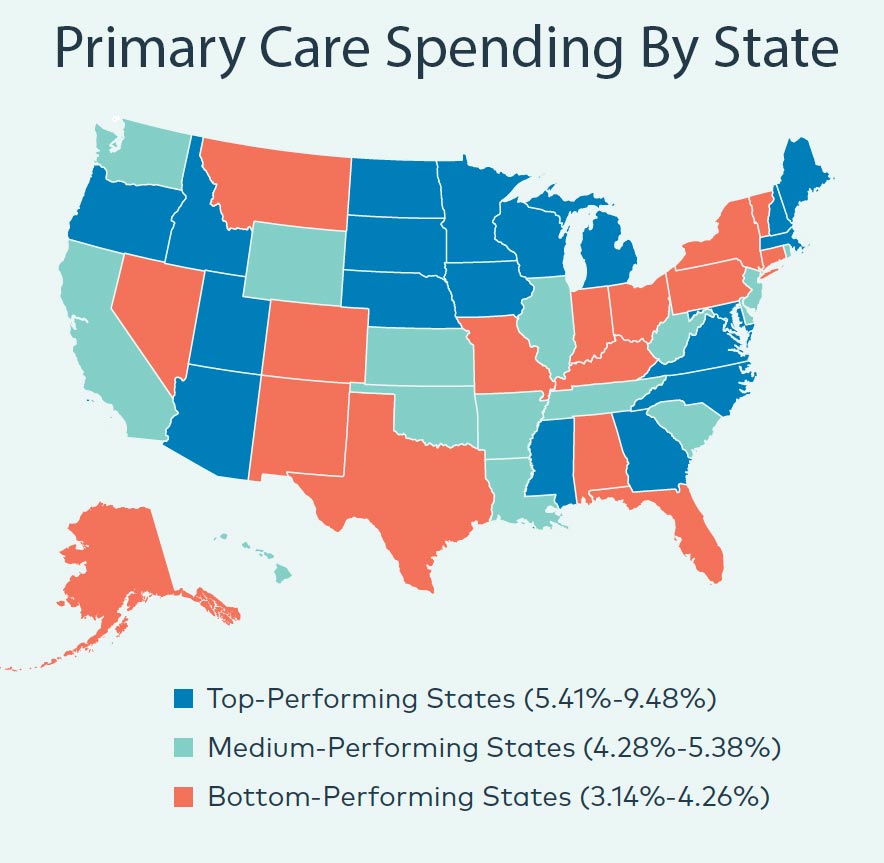
Primary Care Spending: High Stakes, Low Investment

In its broadest look yet at primary care spending, the PCC analyzes spending over time, nationally and in all 50 states, in this year’s research report. The report reveals some alarming trends.


Evidence Report Briefing

This video is a recording of Ann Kempski, lead author of the report, presenting its findings at the report’s release, which took place on December 2, 2020, as part of a PCC workshop on primary care investment at the state level.


Download the 2020 Evidence Report

Primary Care Spending: High Stakes, Low Investment is the PCC’s annual research report for 2020. It shows that the U.S. health system’s investment in primary care, as measured by primary care spending, is low and declined between 2017 and 2019, both nationally and in a majority of states. The findings support a growing body of literature showing that health systems with a foundation of robust, comprehensive primary care achieve better, more equitable health outcomes and are less costly.

Executive Summary

The Executive Summary provides an overview of the 2020 PCC Evidence Report. This concise version summarizes the qualitative and quantitative findings.


2019 Evidence Report

View the 2019 evidence report that the 2020 report is built on.

News Release

View our press release for this report: “PCC’s New Report Sounds Alarm on Low and Declining U.S. Primary Care Spending” from 12/03/2020.


Sponsors

The Primary Care Collaborative thanks the following PCC board of directors’ organizations for their generosity. Their support made the 2020 Evidence Report possible.