
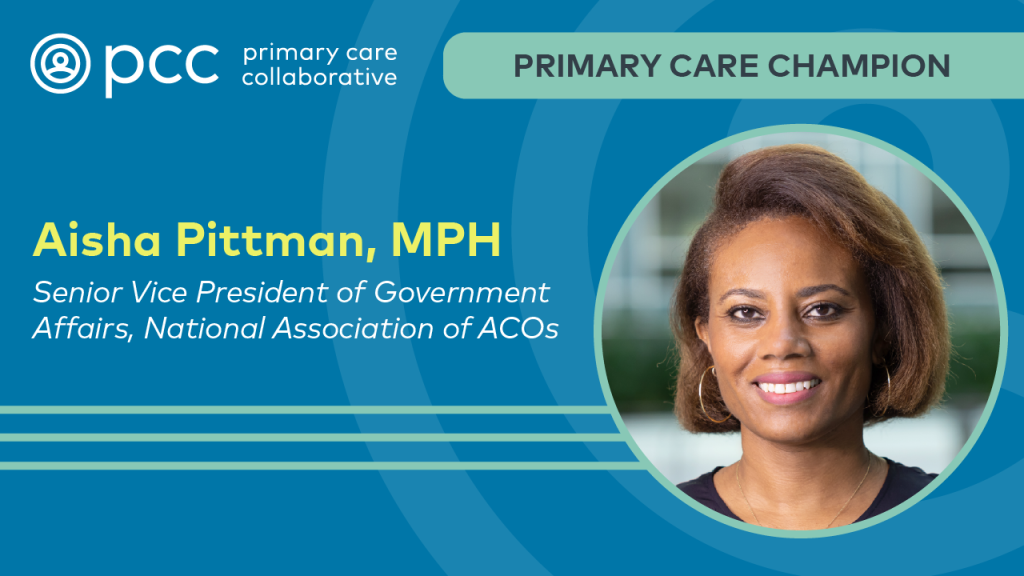
Primary Care Champion: Aisha Pittman, MPH
The Primary Care Collaborative (PCC) is delighted to name Aisha Pittman, MPH, as our latest Primary Care Champion. Pittman serves as Senior Vice President of Government Affairs at the National Association of ACOs (NAACOS).
To begin the conversation, Pittman discussed her passion toward strengthening high quality whole-person primary care. Through her initial health care quality background in organizations like NCQA and the National Quality Forum, she discovered how payment incentives don’t always align with patient outcomes. She sees accountable care as a critical means to connect payment to results, with primary care as its backbone.
Next, Pittman dug into the impact of the ACO approach. The Medicare Shared Savings Program has shown the ACO model can work, generating more than $34 billion in savings over nearly 15 years. Forgoing the care and reimbursement limitations of fee-for-service, ACOs give care teams more flexibility to use shared savings where they’ll best serve patients. This includes hiring care managers, adding staff, using technology to help patients manage their care at home, providing 24-hour call-line services and other crucial care for a more integrated primary care system.
She then identified several challenges for primary care and described how NAACOS hopes to address them:
- Workforce and payment pressures: As primary care faces workforce challenges, annual cuts under budget-neutral Part B payments and undervaluation, ACOs can help practices make better use of team-based care.
- ACO sustainability: Successful ACOs may have their benchmarks rebased when they recontract, reducing the savings available to sustain services. Pittman called for more stable, longer-term benchmarks.
- Flexible upfront payments: Pittman wants stronger hybrid-payment and capitation options in the Medicare Shared Savings Program, noting that ACO PC Flex had limited uptake and could be restrictive.
- Different practice needs: According to Pittman, practices within an ACO should be able to choose or transition between payment approaches based on readiness and their arrangements with other payers. More upfront funding could support care investments and shared services.
She said these options could provide more upfront funding for practices to invest in care or pool resources for shared services, ultimately increasing investment in primary care.
Finally, Pittman outlined her wish for the expansion of accountable care across the health care system. She wants all traditional Medicare beneficiaries to have an accountable care relationship, through Medicare Advantage or an ACO and more value-based contracts across Medicare Advantage, Medicaid and commercial insurance. According to Pittman, giving practices and clinicians the tools and control to improve care can lead to better outcomes and savings.
This summary utilized AI tools for drafting support and editing.


